2010-06-14

Smart way for baking the loose dough

Today I discovered a new way of baking the rye bread. As you know this bread is difficult to form and bake because the dough can hardly keep its shape. If you don't have a basket for proofing, this is the idea for you!

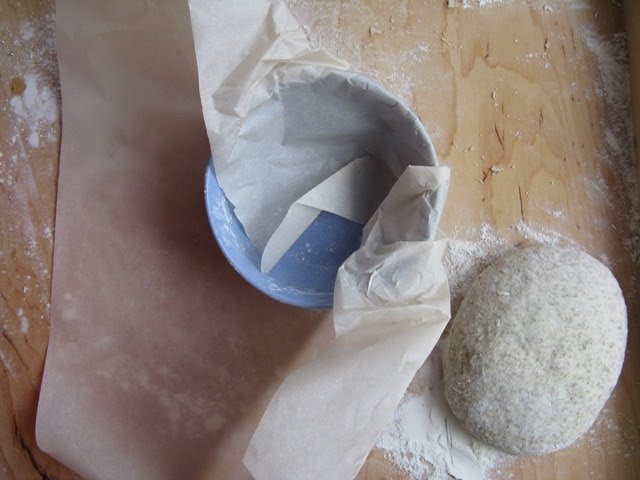
Cut a piece of a parchment paper, place a bowl of the desired bread size in the center and wrap the dish.
Oil the inside of the 'paper bowl' and dust with flour if you prefer. Then carefully remove the bowl and wrap the paper itself into the bowl's shape.
Place the shaped loaves in your paper moulds. Now arrange the moulds on the baking tray leaving some space between separate breads. Cover with a wet cloth and leave for proofing.
Brush or dust the risen bread and cut the top as you do normally.
Admire and enjoy the look and the smell of the ready loaves. Now's the time for taking pictures actually!
No mercy for a single slice!

2010-06-01

Beer soup - a must for a beer lover

As we are talking about the Old Polish (baroque) cuisine it is necessary to mention the beer soup. It was a custom to start a day with this noutritious soup or another in kind of borsch or a soup made of the fermentated rye flour.

The beer soup was extremely popular not only to its distinctive flavour (you know what I mean) but also due to the fact that it supplied the people with vitamins (vitamin B and niacin) that could be hardly achieved within their dull and simple diet. The proteins from the yeasts (contained in beer) supplied them with all the indispensable amino acids. That was so important as the peasants usually don't eat much meat but mainly grains. The gentry ate it with cheese and eggs added. It must be a nice dish especially that many of the nobility were producing their own beer. The habits has changed much since then. The fashion of eating bread for breakfast came from France in the XVIII century and it finally won. We don't eat the nourishing soups in the morning today but commonly we eat sandwiches.

Beer soup with croutons- recipe

500 ml beer
150 g sour cream (18% fat) or double cream
2 egg yolks
2 slices of bread (preferably Russian rye bread)
3 Tbsps sugar
pinch of cinnamon

1. Cut the crust off the slices and cut the crumb into small cubes. Brown the cubes on the dry frying pan.
2. Cut the bead crust into small segments. Keep 2 tablespoons of beer separately. Bring to boil the rest of beer with the crust. Let it become overcooked.
3. In a pot mix the cream with the egg yolks, the cold beer and a tablespoon of sugar.
4. Slowly add the warm beer to the cream, stirring constantly. Place on the stove and heat slowly, stirring. Heat it well but do not boil! (Aha, here you can smell the amazing almond aroma).
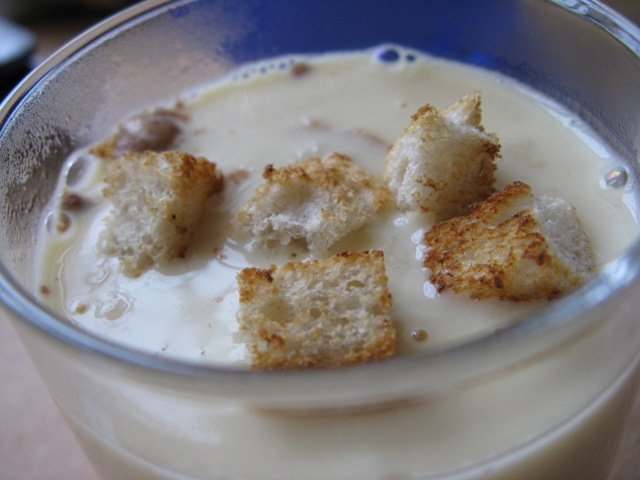
5. In a bowl or a cup place a teaspoon of sugar and a dash of cinnamon. Pour in the soup and sprinkle with the croutons.


Makes 2-4 portions, depends on how you like the soup. I warn, if you use a strong beer, you will get a strong, aromatic, a little bitter soup with this amazing almond aroma. The soup does not become thick but still i can fill you up. Croutons are generally not necessary for that. If you like beer, this soup is really great.

2010-05-15

Influence on Polish cuisnie - part 3 - Beef Strogonow


Polish and Russian cuisines are similar to each other. Both of them have the same Slavic origin and the same taste. Russia is big country and has many local cuisines. Some of them influenced Polish cuisine but if you ask Polish about Russian cuisine they will think about Moscow and Sanct Petersburg areas. Why? Because both cities were capitals of Russia and both of them were identified with the dream of richness and affluence but also with scary enemies of Polish nation.
In the past the business connections and wars initiated a flow of people between the countries, who brought lots of new things and ideas. In this way there came samovar and tea to Poland and the first French recipes and chefs arrived to Russia. This continual flow added new meals to both cuisines. Today in Poland we have lots of Russian recipes which are very popular like Beaf Strogonow.
This dish was thought up probably by French chef Careme for Count Pavel Stroganov but this dish has a few different stories about its origin. Which one is true? I don't know. I know who first made this dish in my family.
This person was my great grandma. She was born in Lviv, now it is Ukrainian city but before Second World War it was Polish place with mixed Polish and Russian influence. In my great grandma home this dish was very popular on special occasions. When my grandma moved to Cracow she brought all family tradition from Lviv and of course recipe for Beef Strogonow. She serves this dish only during her birthday party and it is the best Strogonow I've ever eaten. You can find my grandma recipe below.

Beef Strogonow

500 g beef loin
2 medium onion
100 g mushroom
2 tbs butter
2 tbs tomato puree
½ glass of sour cream
1 ½ glass of stock
2 tbs flour
salt, black pepper, hot pepper

Cut meat to strips and coat it with flour. Cut onion in square and fry it with butter. Cut mushroom to slices. Add meat when onion has gold color and fry on high heat. Add mushroom and fry a few minutes. Add stock, cream, tomato puree salt, black pepper and hot pepper. Stew 10 min. Serve hot with bread or fry potatoes.

Enjoy! Приятного аппетита! Smacznego!


----------
Similar Posts:

Influence on Polish cuisine - part 1 - Japanese herring - śledź po japońsku

Influence on Polish cuisnie - part 2 - Knuckle of pork in Bavaria - Golonka po Bawarsku

2010-05-13

Fish in aspic - another Polish classic

Jellied fish is the traditional Polish dish mainly for the Christmas dinner but it is also served during the Easter. Yet this is a good opportunity to make a nice aspic :-) The measures are given for two portions but you can easily double or triple it and so on. Not everyone likes it as not everybody loves the fish. This dish allows us to use our imagination for the decoration. Every aspect of making an aspic can be practised here. It is a foolproof recipe despite the strange-sounding name.

Fish in aspic
(2 portions)

300 g fish leftovers i.e. head, backbone, tail, a piece of the fish flesh
(I used the bream tail piece with much flesh)
60 g carrot diced
20 g onion cubed
500 ml water
3 allspice grains
5 g salt
1 egg white
5 ml white vinegar
13 g gelatine
1 small spring onion chopped

1. Cook a stock from the fish leftovers, carrot, onion, water, salt and allspice. When the flesh is done take it out and separate from the fishbones. Keep separately. Cool down the stock. It will set into a light jelly.

2. Dissolve the gelatine in a minimum of hot water. Beat the egg white slightly. Add the gelatine, the egg and the vinegar to the stock. Bring slowly to the boil.

3. Observe how the jelly is clarifying. When the egg white coagulates and the liquid becomes transparent sieve through a linen placed on the sieve. Double the sieving if necessary. Cool down completely.

4. Prepare two small containers - some yoghurt pots are fine. Grease it slightly inside using a piece of cloth dipped into the vegetable oil.

5. Place the carrots on the bottom and cover with a little of the jelly. Place the pots in a fridge for about 10 minutes (but not the rest of the jelly!).

6. When the jelly in pots sets place the fish flesh on it and pour down the jelly mixed with the chopped spring onion. Pour down the rest of the jelly and place in the fridge.

7. To take the set jelly out dip the pot in the boiling water for a 5 seconds and turn out onto a plate. Serve with white vinegar (I like particularly the light synthetical vinegar but you can experiment) and slices of bread.

Do not try to add more gelatine - it is not necessary. The jelly should melt in the mouth and not be rubber. To give it a noble flavour add 2 tablespoons of the white wine to the cold stock before the second boiling. If the jelly sets before you use it do not panic, heat it slightly, cool down and use. The fish jelly has a nice mild flavour which tends to get strength if combined with the fish flesh. Clarifying is not necessary but the difference is huge - the transparent jelly looks very elegantly. You can arranged different vegetables in pictures or layers using whole pieces of flesh and parsley leaves as well. Use your imagination. Traditionally the fish in aspic is placed in some separate pots or cups for everyone or arrange on one big plate to share. Try it!


2010-05-01

Home-made hard cheese

Long time ago all the housewives in Poland knew how to make this cheese. How much did we lost due to the so called modern civilisation! Anyway, it is still possible to make the cheese with no need of using the rennet. I have found a good way to make it at home here. I give the smaller proportion as I did it. I add more butter than in the original recipe. Thank you Anek for sharing the recipe!

Home-made hard cheese

200 g cottage cheese (this is easy to make - if you wish)
20 g butter
salt to taste
baking soda
herbs (optional)

1. Place the cheese in a pot on a low fire. Stir frequently until it boils up. Place on a sieve to drain.
2. Bring back to the pot adding butter, salt and herbs. Check the taste and add more salt if needed. Stir until the mass becomes homogenous.
3. Add a pinch of baking soda to the pot. The cheese will become fluffy and then stretchy.
4. Leave to cool - you can shape the cheese.
5. If you wish the cheese to mature - keep it in a cold place and brush every several days with the the olive oil. I also salt it.

The cheese preserves really well. It has a real home-made taste which is worth this few simple steps. Enjoy!

2010-04-25

Influence on Polish cuisnie - part 2 - Knuckle of pork in Bavaria - Golonka po Bawarsku


Russia and Germany are neighbours of Poland that has a big influence on Polish history and cuisine. German influence on Poland is as long as long is Polish history. Even the old Polish legend tells about beautiful Polish princess Wanda and German prince who propose her but she didn't want political enemy for husband. Finally Wanda committed suicide in order not to get married. This prehistorical story was first telling about difficult relation between the two neighbours. But there were a few events a little more optimistic. First king of Poland hosted German emperor Otton III in Gniezno and this meeting included Poland to the group of modern European countries. First monks in Poland were German and they brought not only new religion, education but also new dishes. Strange history made us sometime enemy and it divided both nations but common cuisine is part of sour history which always join. Now it is difficult to say which meal have a German influence on Polish cuisine or the opposite. In both countries people like pork meat, beer, and cabbage and potatoes. Schabowy and golonka are of German origin but kasza and use a lot of spices are Polish influence on German cuisine.
Today's recipe is a dish that German and Polish men like very much especially with beer .

Knuckle of pork in Bavaria
for 2 portions

2 knuckles of pork (each about 1 kg)
30 g. lard
0,25 l warm water 
1 onion 
0,25 l stout beer
pepper, salt, 2 bay leaf, 2 cloves

Wash in warm water knuckles of pork and incise skin. After you use a lot of salt and pepper to sprinkle skin of knuckles. Heat up lard in large pan and fry knuckles of pork. Put meat in baking pan, add sliced onion, water  and rest spices .  Put meat into the oven at 200 Celsius degrees for around 60 minutes. Bake next 60 minutes and sometimes pour beer on top of knuckles of pork. If meat isn't ready after this time add a little water and bake as soon as meat is baking. I always check tempature inside meat - meat is ready above 75 Celsius degrees. My uncle sometimes
instead fry, boiled knuckles of pork and bake just 60 minuet but it isn't Bavarian style. 
Serve hot with salad with cabbage, potatoes and beer.

Enjoy! Guten appetit!


----------
Similar Posts:

Influence on Polish cuisine - part 1 - Japanese herring - śledź po japońsku

Influence on Polish cuisnie - part 3 - Beef Strogonow

2010-04-11

Poland in mourning


“President Lech Kaczynski and his wife Maria were killed, along with a number of other senior Polish political, military and cultural figures, when their plane crashed as it prepared to land in western Russia on Saturday 10 April 2010. “ BBC news

This news went all over the world yesterday. For Polish people it is a big tragedy, for me too. I'm lost for words about what happened. Lech Walensa said yesterday: “ Poland second time lost our patriots in Katyn”.
Polish history is marked with the next tragic date related to Katyn.

April 1940 Katyn massacre

10 April 2010 the Polish Goverment plane crashed in Smolensk

LinkWithin

Related Posts Plugin for WordPress, Blogger...