Showing posts with label soups. Show all posts

2011-12-07

Christmas Eve - Dish 6 - mushroom soup

Las / Forest 

There are many types of soup which are served on Christmas Eve. Apart from fish soup, borscht is the most popular but mushroom soup is also well-known. In my family there are always two soups served on Christmas Eve - borscht and mushroom soup with dried wild mushrooms.

The smell of cooking mushrooms reminds me of Christmas in my Polish home and of my childhood. I love that smell and there are always Polish dried mushrooms in my kitchen even if I'm in a very distant place.


60 grams of dried mushrooms
2 carrots
1 onion
1 tbsp butter
3 tbsp fresh cream
salt, black pepper
2 l. vegetable broth

łazanki (Polish pasta cut into squares) or other small pasta


Soak mushrooms overnight in 4 glasses of water. Cook mushrooms slowly until they are boiled. Strain mushrooms. Cut mushrooms into small pieces. Add mushroom broth to vegetable broth and boil. Clean and peel carrots, cut into thin slices and add to broth together with salt, and cook unlit carrots are soft. In the meantime cook pasta. Cut the onion into small pieces and fry on butter until gold. Add the onion and mushrooms to soup and cook 5 minutes. Next add pepper and fresh cream. Strain pasta, add to soup and serve.


2011-11-06

Dublin Bay chowder with scampi


Dublin Bay I

In every good restaurant in Dublin you can find scampi or Dublin Bay Prawns in the menu. It is the same shellfish. Scampi look like a prawn but it is not. It is a slim, orange-pink lobster which grows up to 25 cm long, and is the most important commercial crustacean in Europe.
I tried scampi during my first dinner in a restaurant in Dublin. It was my second day in Ireland and we celebrated my arrival.
I ordered the strangest dish in the menu as a starter. It was Dublin bay chowder with scampi. I was very much surprised when in my soup I saw familiar to me ingredients and I asked the waiter which one were scampi. He pointed at pink prawns. At that time I thought that scampi is the Irish name for prawns. I'd probably be in this belief if I hadn't attended the Dublin Bay Prawn Festival. A lady explained to us that scampi are a type of lobster, and she was proud of Dublin cuisine. Scampi are served in hundreds of sophisticated ways but my favourite is Dublin bay chowder with scampi. 

Dublin Bay Prawns


Dublin Bay Chowder

For two

2 Tbsp Butter
2 Tbsp flour
1 Tbsp each minced green onion, celery, fennel
1 tsp tomato puree
200 ml clam juice (or mild fish stock)
100 ml milk
½ cup medium shrimp (peeled, deveined, tail removed)
½ cup bay scallops
1 tsp each fresh chopped parsley, dill
pinch cayenne pepper
salt & white pepper to taste
1 Tbsp heavy cream


In a heavy saucepan melt butter. Add green onion, celery, fennel. Sweat until translucent. Add flour. Cook 4-5 minutes (do not allow to darken.) Add tomato puree.
Add clam juice. Bring to boil. Lower heat to simmer. Add seafood. Cook 1 minute.
Season with white pepper, cayenne and salt.
Add fresh herbs and heavy cream. Simmer 1 more minute.

Serve in warm soup plates with crusty, warm bread.


2011-06-05

The Jews influence on the Polish cuisine - Szlajmzupe

The Jews were settled in Poland during the reign of Boleslaw Chrobry  Casimir III the Great was favourably disposed towards the Jews. On 9 October 1334, he confirmed the privileges granted to Jewish Poles in 1264 by Bolesław V the Chaste. Under penalty of death, he prohibited the kidnapping of Jewish children for the purpose of enforced Christian baptism. He imposed heavy punishment for the desecration of Jewish cemeteries. King Casimir allowed them to settle in Poland in great numbers and protected them as people of the king.
                                                                                          Wojciech Gerson - Jewish and King Kasimir

In 1492 Spain and a few years later Portugal and other countries drove the Jews out of their territories. Some of them moved to Poland. The Jews became an important part of  Polish  economy and culture.

Many of the dishes and many methods of processing and storage of food in Polish cuisine are owed to the Jews. Sweet juice, cooking fish and veal, cholent and other dishes prepared by the Jews during the Sabbath have survived in Polish homes to this day.

                                                                                       Aleksander Gierymski -Jewess with Lemons

In Jewish cuisine   kosher food as a form of respect for biblical health rules, officially scorned by Poles, is used. However, these rules played a significant role in the slaughter and cutting up the animals in Poland. Indeed, Poles pay special attention to the Jewish model of slaughter where  the purity of place and sharpness of the tools which are use to slaughter are important. Of course, nobody dissuaded Poles from eating  pork, but Polish cuisine has adopted a number of recipes, ingredients and spices used in Jewish cuisine.

My favourite dishes coming from Jewish cuisine are Jewish carp, Cholent, Szlajmzupe, Holiszki, Challah,


Below there is a recipe for Szlajmzupe which is often served by my grandfather.

150 gram the offal of geese (wings, legs, stomach)
150 grams of mixed vegetables (no cabbage)
150 grams barley groats (Pearl)
2 dried mushrooms (porcini)
Salt, pepper
1 tablespoon chopped parsley
1 cup of cooked beans

Cleaned and washed offal put into boiling water (4 cups).  Boil and afterwards peel meat from the bone, cut meat and stomach into small pieces and put into the broth. Rinse barley, pour in the broth and cook slowly. Grate purified vegetable large mesh, pour three cups of water, add  soaked and cleaned mushrooms and cook until soft. Add the broth with vegetables to the broth with barley, season to taste with salt and pepper, bring to boil. Serve with cooked beans, which were cooked separately with chopped parsley.

2011-01-08

Korean seaweed soup

It is so amazing how many times Korean food has inspired me! I am devoted lover of the Korean pancakes among others. Although Gosia has inspired me more frequently, to be true. Last time I got a nice package of the dried seaweed that I love. As I felt that the cold is attacking me, I decide to prepare some warming soup.
(2 portions)

4-6 pieces od dried seaweed
2 drops chilli sauce
1 Tbsp dark soy sauce
1 tsp fish sauce
1 tsp rice vinegar
1/2 carrot
1 small onion
1 garlic clove
cooked rice

1. Soak dried seaweed in cold water until soft. Drain and cut into smaller pieces
2. Cut carrot into julienne stripes and onion into fine slices.
3. Place together in a pot seaweeds, carrots, onions, 500 ml water, dark soy sauce, chilli sauce and fish sauce. Bring to the boil, boil for few minutes. Season with vinegar and salt if necessary.
4. Place cooked rice in a bowl, pour in the soup, sprinkle with the finely chopped garlic clove.

Simple but nourishing. And it helps my brain, they say. I guess I may like Korea. 

And what is your favourite recipe for seaweeds? Krakow visitor's pack for the best proposition! You have a week for entries, starting from now on till 14th of January. Please place your proposals in comments. Happy cooking!

2010-11-21

Thai pumpkin soup


The natural sweetness of the pumpkin is heightened by the addition of a little sugar in this lovely looking soup, but this is balanced by the chillies and shrimp. This is my version of Thai shrimp and coconuts soup. Please you can try, it is so tasty.


For six portion

450 gram peeled pumpkin
2 garlic cloves, crushed
4 shallots, finely chopped
½ tbsp. of shrimp paste
2 fresh green chillies, sliced
600 ml of chicken stock
½ tbsp. of sugar
500 ml coconuts milk
30 ml of Thai fish sauce
150 gram small cooked shrimps
1 tbsp. coconuts oil
Black pepper, salt.


Cut pumpkin into quarters. In pot heat coconuts oil and put garlic, shallots, shrimp paste, green chillies, sugar and salt and fired they 1 minute. Add chicken stock and stir soup. Add pumpkin and simmer about 15 minutes until pumpkin is tender. Add fish sauce and coconuts milk and boil 5 minutes. Add prawns and cooked next 3 minutes. Serve warm soup and garnish black pepper.
Enjoy!

-----------
Similar Posts:

Pumpkin cookies

Pumpkin soup
Time of Hallowe'en

2010-11-01

Pumpkin soup

Halloween means for me only one thing - pumpkins. Every year I cook a few dishes with this nice vegetable. This year Thai cuisine and new polish dishes are my inspirations.
The first dish is a soup. The recipe combines elements of Polish cuisine and Asian spices. The soup has a rich flavour and beautiful bouquet of smell. When I prepared the dish this nice smell was in whole my apartment. I felt like in oriental country though behind the window it was Irish grey day.

Try this soup. It is good for a cold day.

0,5kg sliced pumpkin in big pieces
5 tbsp of oil
3 tbsp of yellow curry powder
1 tbsp salt
1 tbsp ground black pepper
2 cloves chopped garlic
2 tsp fish sauce
4 tsp Soya sauce
500 ml of hot water
250 ml of coconut milk

Preheat oven to 200 degrees. Oil, curry powder, salt, pepper and garlic mix together.
The mixture spread on every piece of pumpkin and put on baking tray. Bake for 25 minutes at 200 degrees.

After baking, pieces of pumpkin and water put into blender and mix well.
Transfer pumpkin cream to pot and add coconut milk, Soya sauce and fish sauce and cook soup.


Serve with pumpkin seeds and fresh cream.

Enjoy!!!

---------
Similar Posts:

Pumpkin cookies

Thai pumpkin soup
Time of Hallowe'en

2010-09-23

Celeriac cream soup

Early and cold this year's autumn is a fact. That is why we are going to use the whole splendid celeriac the good mother-in-law we are given by.

 Celeriac cream soup
(two portions for abnormal, according to Septime, people or 4 for the others)


1 medium (about 10 cm in diameter) celeriac with leaves
4 medium size potatoes
2 carrots
1 onion
1 tomato
fresh ginger 3 slices
50 g butter
1,5 l vegetable or chicken stock (can be from cube)
half tsp nutmeg salt and pepper to taste
thick cream and fresh chopped parsley for finishing

1. Peel and cut vegetables into chunks.

2.  Soften the celeriac leaves on butter on medium heat in a pot.

3. Add the vegetables and ginger and cover with stock. Bring to boil.

4. Cook until the vegetables are soft. Blend well and season.

5. Decorate with a dollop of a thick sour cream or plain yoghurt  and some chopped parsley. Serve with yummy bread. I am in.

2010-06-01

Beer soup - a must for a beer lover

As we are talking about the Old Polish (baroque) cuisine it is necessary to mention the beer soup. It was a custom to start a day with this noutritious soup or another in kind of borsch or a soup made of the fermentated rye flour.

The beer soup was extremely popular not only to its distinctive flavour (you know what I mean) but also due to the fact that it supplied the people with vitamins (vitamin B and niacin) that could be hardly achieved within their dull and simple diet. The proteins from the yeasts (contained in beer) supplied them with all the indispensable amino acids. That was so important as the peasants usually don't eat much meat but mainly grains. The gentry ate it with cheese and eggs added. It must be a nice dish especially that many of the nobility were producing their own beer. The habits has changed much since then. The fashion of eating bread for breakfast came from France in the XVIII century and it finally won. We don't eat the nourishing soups in the morning today but commonly we eat sandwiches.

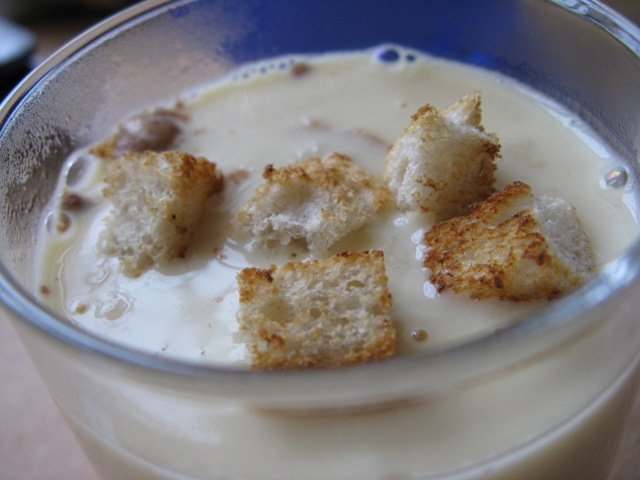
Beer soup with croutons- recipe

500 ml beer
150 g sour cream (18% fat) or double cream
2 egg yolks
2 slices of bread (preferably Russian rye bread)
3 Tbsps sugar
pinch of cinnamon

1. Cut the crust off the slices and cut the crumb into small cubes. Brown the cubes on the dry frying pan.
2. Cut the bead crust into small segments. Keep 2 tablespoons of beer separately. Bring to boil the rest of beer with the crust. Let it become overcooked.
3. In a pot mix the cream with the egg yolks, the cold beer and a tablespoon of sugar.
4. Slowly add the warm beer to the cream, stirring constantly. Place on the stove and heat slowly, stirring. Heat it well but do not boil! (Aha, here you can smell the amazing almond aroma).
5. In a bowl or a cup place a teaspoon of sugar and a dash of cinnamon. Pour in the soup and sprinkle with the croutons.


Makes 2-4 portions, depends on how you like the soup. I warn, if you use a strong beer, you will get a strong, aromatic, a little bitter soup with this amazing almond aroma. The soup does not become thick but still i can fill you up. Croutons are generally not necessary for that. If you like beer, this soup is really great.

2009-04-06

Liquid curry

'What do I have to buy for the soup? What are you talking about?! One onion, one apple, one lemon?!' Yes, that's for the mulligatawny soup, of Anglo-Indian origin and of the name meaning literally 'pepper water' in Tamil.

Mulligatawny soup

1 onion
1 apple
1 garlic clove
2-3 Tsp oil
1 heaped tsp of curry powder
3 Tbsp flour
1,5 l chicken stock
1 Tbsp of lemon juice
salt, sugar, parsley, cream (30-35% fat)
180 g rice (for 4 people)

1. Boil rice in salted water. Cut onion and apple into small cubes, chop garlic. Heat the oil in the pot, brown lightly onion and apple, stirring frequently. Add garlic.

2. Add curry powder, mix adding some stock to avoid burning.

3. Sprinkle onion and apple with flour, mix well avoiding lumps, add stock if necessary.

4. Slowly pour in the pot all the chicken stock. Cook for another 10 minutes.

5. Season with lemon juice, salt and a pinch of sugar.

6. Serve with rice tower in the soup bowl, granished with fresh parsley and a spoon of cream if desired - this will smooth the texture and balance the flavours.

Again, something really simple can be very tasty. And quick. As well as attractive. And filling-up. And... and...

So we eat the soup of a strange name second time in three days. Because it is so delicious. Winter has gone now, but remember this recipe, certainly it is going to be your favourite also.

2009-03-04

Winter leeks

I love two vegetables: tomato and leek. For me tomato means – summer and hot months. Leek means – dark, cold, long winter nights and hot soup.

Leeks have a mild onion-like taste, although less bitter than Scallion. The taste might be described as a mixture of mild onion and cucumber. It has a fresh smell similar to scallion. In its raw state, the vegetable is crunchy and firm.

Leeks have a long and rich history, one that can trace its heritage back through antiquity. Thought to be native to Central Asia, they have been cultivated in this region and in Europe for thousands of years.
Leeks were prized by the ancient Greeks and Romans and were especially revered for their beneficial effect upon the throat. The Greek philosopher Aristotle credited the clear voice of the partridge to a diet of leeks, while the Roman emperor Nero supposedly ate leeks everyday to make his voice stronger.
The Romans are thought to have introduced leeks to the United Kingdom, where they were able to flourish because they could withstand cold weather. Leeks have attained an esteemed status in Wales, where they serve as that country's national emblem. The Welsh regard for leeks can be traced back to a battle that they successfully won against Saxons in 1620, during which the Welsh soldiers placed leeks in their caps to differentiate themselves from their opponents.

Today, leeks are an important vegetable in many northern European cuisines and are grown in many European countries especially in France as the key ingredient in vichyssoise. The Vichyssoise soup is a cold potato leek soup with a French name and it was invented not in Paris or Lyons or even in Vichy, France, but in New York City at the beginning of the 20th Century.
It was 1917 and the fashionable Ritz-Carlton Hotel on Madison Avenue at 46th Street was about to open the new roof garden restaurant. The head chef was a Frenchman named Louis Diat. He often made a potato and leek soup from a recipe given to him by his mother, and he was preparing to serve it at a party celebrating the opening of the roof garden. Whether, according to legend, the soup prepared in advance wasn't re-heated in time to be served as a first course, or whether the day was warm and Chef-de-Cuisine Diat was creative, he added cream to his mother's soup recipe and served it cold, sprinkled with chopped chives. He called it Crème Vichyssoise Glacee, or Chilled Cream Vichyssoise, in honor of the town where he was born.

In France a leek soup is popular among women because it is a basic ingredient of the eat-clean diet. You can find a recipe for that diet in the book “French Women Don't Get Fat” of Mireille Guiliano . She wrote that soup makes miracles and that diet is a fast way to a slender figure. Maybe, but whole French cuisine and wine are a good way to be skinny and healthy.
So, the Vichyssoise soup, Mireille Guiliano soup or my French leek soup is the same but my dish is very hot.
In winter I often prepare leek soup because it is my favorite dish. This soup is very easy and quick to make. Keep it in the fridge and heat up it when you get back home on a cold winter’s night...

What you need:

Ingredients for 4 people
- 2 large potatoes
- 2 large leeks
- 1 onions
- ½ cup milk
- 3 tbs olive oil
- 2 tbs freshly chopped parsley
- 1/2 liter [1 pint] warm water
- salt, pepper and nutmeg

1) Peel and cube the potatoes. Peel and mince the onions. Prepare the leeks (wash them and take a 1/3 of the top leaves off) and slice them.

2) Put the onions and leeks in a saucepan, heat the oil and gently mix onions and leeks. Cover with a lid and braise on a gentle flame for about 10 minutes.

3) Add the cubed potatoes, salt and pepper, and 1 or 2 pinches of nutmeg ;
add the water and milk. Simmer for another 15 to 20 minutes.

4) Adjust salt and pepper, and serve soup on each plate sprinkled with chopped parsley.

If you prefer another herb to change or wish to vary the flavors: coriander, basil or tarragon would be fine.

Enjoy! Bon appetit!

2009-01-04

Borscht

In Poland Christmas Eve supper begins Christmas time.
In Polish tradition it is a special and very important night.Families meet together and eat Christmas Eve supper. Before the supper everybody gives Christmas greetings and people break a Christmas wafer opłatek . Christmas Eve is a family day. It is love and reflection day. That day everybody quickly finishes work and goes home. After midday Polish town and village is quiet because everyone is at home and prepares Christmas tree, gifts and supper.It is a hard work day for women, because they must prepare many dishes.

The traditional Christmas Eve supper consists of twelve dishes representing the twelve months of the year or twelve apostles. No meat is served during the supper, only fish, usually herring, carp or pike. Other traditional dishes appearing on the table include red borscht, mushroom or fish soup, sauerkraut with wild mushrooms or peas, dried fruit compote and kutia, a dessert especially popular in eastern Poland. Boiled or fried pierogi, Polish dumplings with a wide variety of fillings, are among the most popular Polish dishes. For the Christmas Eve supper, pierogi are usually made with sauerkraut and mushrooms.

For me very traditional Christmas Eve dish is barszcz z uszkami. What is it?
Barszcz in English borsht is a soup with beetroot. The basic Polish borscht recipe includes red beetroot, onions, garlic, and other vegetables such as carrots and celery or parsley roots. The ingredients are cooked for some time together to produce kind of clear broth (when strained) served as boullion in cups or in other ways.

Other versions are richer as they include meat and cut vegetables of various kinds where beetroots aren't the main one (though this soup isn't always called barszcz, but rather beetroot soup). This variation of barszcz isn't strained and vegetable contents are left in it. Such soup can make the main course of obiad (main meal eaten in the early afternoon).

Barszcz in its strictly vegetarian version is the first course during the Christmas Eve feast. As other Christmas traditions, barszcz served at that time has its own symbolic meaning. Most of food served at that time isn't quite the food of the living ones, but of those that passed away. Dried fruit, mushrooms — all symbolise death of the old year as opposed to birth of the new one a day later. Change of food on December 25 (Christmas) is a visible sign that old traditions are still preserved in those little, sometimes unclear ways.

A key component to the taste of barszcz is acidity. Whilst barszcz can be made easily within a few hours by simply cooking the ingredients and adding vinegar, lemon juice or citric acid; the traditional way is to prepare barszcz several days before and allow it to naturally sour. Depending on the technique; the level of acidity required and the ingredients available, barszcz takes 3-7 days to prepare in this way.
Uszka it is small ravioli which look like small ears. They are small dumplings usually filled with mushrooms or minced meat. They are usually served with barszcz, though they can be eaten alone. They are a part of traditional Christmas Eve dish in Poland and Lithuania.

Every family has own recipe of barszcz and uszka, each dish tastes differently but the ingredients are the same.
My family recipe is below.

Soup

Beetroot Sour - kwas buraczany
1 kg beetroots
1 slice black bread
4 buds garlic
1tbsp. sugar
1tbsp. salt

Peel and thinly slice beetroots and place in large crockery bowl or glass jar. Add 1 slice black bread, garlic, sugar, salt. Cover with pre-boiled lukewarm water and cover dish towel and let stand at room temp. 4-5 days until pleasantly tart.

Clear borsch - Barszcz
3 dired willd mushrooms
1 carrot,
1 parsley,
1 celeriac,
1 onion,
1 leek
1 kg beetroots
2 cups beetroot sour
2 buds garlic
1 tbsp. sugar
half appel
salt and pepper

Soak dried mushrooms in water overnight and cook in the same water until tender. Bring vegetarian bouillon (carrot, parsley, cellar, onion, leek) to boiled, add the mushrooms water and simmer 20 minutes together. Peel and cut slice beetroots and add to bullion and simmer 1 hour. Add 2 cups beetroot sour according to the tartness you like and strain. Add 2 buds garlic, 1 t. sugar and half apple. Add salt and pepper if needed. Serve hot with uszka.

Uszka

Mushroom filling for soup dumpling – Uszka

100 gram dried wild mushrooms
1 tbsp. butter
1 medium onion
1 egg
2 tbsp. bread crumbs

Scrub dried mushrooms, soak overnight in water and cook until tender. (reserve mushrooms liquid for barszcz). In 1t. butter 1 slice onion until tender. Grind mushrooms and onion add 1 egg white, 2t. breadcrumbs or more, salt and pepper to taste and mix well. Use as a fill to uszka soup dumpling

Dough for Pierogi or Uszka

½ kg flour
1 egg
pinch of salt
lukewarm water

On a pastry board mix flour, egg and salt, slowly adding water and kneading.The dough is ready if it does not stick to the hand or pastry board. Divide dough into four parts, and roll each one out thinly. With a wine glass cut out circles that are 2 - 21/2 in. in diameter. (For Uszka, cut out small squares). Place a teaspoon of the filling on each circle, fold over and press the edges firmly. Cook for 5 minutes.


The Christmas Eve supper is usually held under candle light and starts in the evening after the first star appears in the sky. The star symbolizes the birth of Jesus in Christian tradition and a soul of deceased ancestors in pre-Christian beliefs. Quiet, dim-lighting, and a somewhat mystical atmosphere is characteristic for Christmas Eve supper. In Poland, an extra plate and seat are always left for anyone, such as a drifter, to be accepted as a guest. It is believed that he may be Jesus and should be welcomed.

2008-11-24

Autumn: cauliflower soup

Too mild to be a base for a tasty soup... Dully grey without much of cream in a creamy soup... Generally sad vegetable with its undeveloped flowers. Yes, I confess my sin, I used to think that way about cauliflower. Then I gave it a try.

Was I seduced by the soup texture? Gentle flavour of the topping? Surprising poignancy behind the innocent look? Or the tawny bread was my true love and inspiration?

What did I use to change my point of view on cauliflower:

for 2 serves

1 cauliflower
600 ml chicken stock*
2 tbsps single cream
salt and black pepper
4 bread slices
2 tbsps butter
1 tbsps breadcrumbs
2 tbsps grated cheese

1. Wash and drain cauliflower. Divide into florets, leave aside 6 smaller florets.

2. Boil remaining cauliflower in the stock together with vegetables and meat, add a little of water if needed. When soft, take from the stove. Blend until smooth. Add cream and mix well. Season to taste with salt and freshly ground pepper (try with mixed peppers if you like), MAKE IT PUNCHY.

3. While boiling cauliflower in the stock, boil the remaining florets briefly in salted water. Immediately transfer into the cold water, cool down and drain. Melt butter in the frying pan, brown breadcrumbs, add boiled florets and combine. Up to this point, this is what the classic cuisine calls chou-fleur à la Polonaise. We go one step further. Place florets on a parchment paper, sprinkle with grated cheese and put under a heated grill for a few minutes (depends on the cheese form you prefer).

4. Heat the frying pan, brown breadslices on both sides.

5. Pour the soup into the dish, carefully place three florets on the top and heavily sprinkle with freshly chopped parsley. Serve along with bread.

* Prepare the stock on chicken bones with some meat, preferably on chicken legs, and vegetables, i.e. carrot, onion, celery. Separate meat from the bones and skin, return to the stock, leave vegetables in the stock. This soup must be nutritious!

Oh yes, so yummy. If you like it, you must try another nice idea.

Worth to remember is that the classic creamy cauliflower soup (with the addition of puréed potatoes) is called crème du Barry and that the method of coating with butter and golden breadcrumbs, called à la Polonaise, applies also to yellow string beans which I found the most delicious. Our (cheesy or not) cauliflower à la Polonaise is not only a decoration, it can be also a good companion to the main course or the dish itself.


Usually I try something new because I knew the story, this time it was the dish that was first. Most of us stop at this point.
Quel dommage!

The name for cauliflower derives from Latin caulis meaning cabbage. Via Italian cavolfiore, 'cabbage flower', English name for this vegetable is attested from 1597.

For certain, Brassica oleracea botrytis belongs to the cabbage family and is the youngest child botanically. We do not know exactly how cauliflower developed. Probably it is a distinguished kind of the white broccoli. Cauliflower and broccoli are basically the same species with the difference that the first one has white (generally...) inflorescence meristem and the second has green (not necessarily...) flower buds. It was already known in the antiquity and highly esteemed by the Romans and the Greeks alike. Then was forgotten for centuries, to be revivified by Louis XIV gardener, Jean Baptiste La Quintinie. And last but not least, I have never thought that so white vegetable can have so many minerals (Mg, Ca, K)... After all, my favourite white food is chocolate.

LinkWithin

Related Posts Plugin for WordPress, Blogger...